
If you’re looking for a small companion dog, you’ve probably narrowed your options to two popular breeds: the Pomeranian and the Toy Poodle. Both are intelligent, affectionate, and well-suited to many Canadian households, but they differ in temperament, grooming, exercise needs, and family compatibility.
This guide compares the Pomeranian vs Toy Poodle to help you understand which breed is more likely to fit your lifestyle. Whether you’re a first-time dog owner, have children, or live in a downtown Toronto condo or a suburban home in Ontario, choosing the right breed starts with understanding their differences rather than simply choosing the cutest puppy.
If you’re considering adding a puppy to your family, you can also browse the Available Puppies page at Yavru Patiler or learn more about individual breeds, including Pomeranian and Toy Poodle, before making a decision.
Pomeranian vs Toy Poodle: Quick Answer
The Pomeranian is ideal for families looking for a bold, lively companion with a big personality in a small body. The Toy Poodle is generally better for owners who want an exceptionally intelligent, highly trainable dog that adapts well to many lifestyles.
Neither breed is universally “better.” The right choice depends on your home, activity level, grooming commitment, and experience with dogs.
Why This Comparison Matters
Small breeds continue to be among the most popular companion dogs in Canada because they adapt well to urban living, require less space than many larger breeds, and form close bonds with their owners.
However, many prospective owners focus only on appearance.
A beautiful puppy may not be the best match if its energy level, grooming requirements, or temperament don’t fit your household. Understanding those differences before bringing a puppy home can help create a happier experience for both your family and your future dog.
Pomeranian vs Toy Poodle: At a Glance
| Feature | Pomeranian | Toy Poodle |
|---|---|---|
| Size | 3–7 lbs | 4–6 lbs |
| Height | 6–7 inches | Up to 10 inches |
| Energy Level | High | Moderate to High |
| Intelligence | High | Exceptionally High |
| Grooming Needs | High | High |
| Shedding | Moderate | Very Low |
| Family Friendly | Yes | Yes |
| Apartment Friendly | Excellent | Excellent |
| Trainability | Good | Excellent |
| Lifespan | 12–16 years | 12–18 years |
Breed Origins
Pomeranian
The Pomeranian belongs to the Spitz family and descends from much larger working dogs. Over time, selective breeding produced the compact companion breed known today.
Despite their small size, Pomeranians remain alert, confident, and surprisingly fearless. Their lively personality often makes them feel much larger than they actually are.
According to the American Kennel Club, Pomeranians are known for being curious, outgoing, and devoted to their owners.
Toy Poodle
The Toy Poodle was developed from the Standard Poodle by breeding for a smaller companion size while preserving the breed’s intelligence and athletic ability.
Originally associated with water retrieving, Poodles became highly valued for their trainability and adaptability.
Today, Toy Poodles are among the world’s most intelligent dog breeds and excel in obedience, agility, and companionship.
The Canadian Kennel Club recognizes the breed for its intelligence, elegance, and willingness to learn.
Size and Appearance
Although both breeds are considered toy dogs, they create very different impressions.
Pomeranian Appearance
A Pomeranian has:
- A thick double coat
- A fox-like face
- Small pointed ears
- A fluffy tail carried over the back
- A compact, rounded body
Their luxurious coat gives them a much larger appearance than their actual weight.
Pomeranians come in numerous accepted coat colours, making them one of the most visually diverse toy breeds.
Toy Poodle Appearance
Toy Poodles have:
- A curly, dense coat
- Long legs relative to body size
- Elegant posture
- Dark expressive eyes
- A refined facial structure
Their curly coat traps loose hair rather than allowing it to fall freely, making them a popular choice for households concerned about shedding.
Personality and Temperament
This is often where the decision between Pomeranian vs Toy Poodle becomes much easier.
Both breeds are affectionate, but they express their personalities differently.
Pomeranian Personality
Pomeranians are:
- Confident
- Outgoing
- Curious
- Alert
- Loyal
- Playful
Many owners describe them as “big dogs in tiny bodies.”
They love interacting with people and often enjoy being the centre of attention.
Their alert nature also makes them surprisingly good watchdogs, although they can be vocal if not properly trained.
A well-socialized Pomeranian usually enjoys meeting visitors while remaining devoted to its family.
Toy Poodle Personality
Toy Poodles tend to be:
- Calm
- Highly intelligent
- Sensitive
- Gentle
- Affectionate
- Adaptable
Rather than relying on boldness, Toy Poodles often assess situations carefully before reacting.
They typically bond deeply with family members and enjoy participating in daily activities.
Their intelligence allows them to understand routines quickly and respond well to consistent training.
Which Breed Is More Intelligent?
Both breeds rank highly among companion dogs, but the Toy Poodle is widely regarded as one of the most intelligent dog breeds.
Toy Poodles often:
- Learn commands quickly
- Solve problems independently
- Respond well to structured training
- Enjoy mental stimulation
- Perform exceptionally in obedience
Pomeranians are also intelligent but can sometimes display an independent streak, which may require extra patience during training.
Which Breed Is Easier to Train?
Toy Poodle
The Toy Poodle generally has the advantage.
They:
- Learn quickly
- Enjoy positive reinforcement
- Like structured routines
- Stay focused during training sessions
This makes them an excellent choice for first-time owners willing to invest time in training.
Pomeranian
Pomeranians are capable learners but may become distracted more easily.
Training succeeds best when sessions remain:
- Short
- Positive
- Reward-based
- Consistent
Early socialization helps reduce excessive barking and improves confidence around unfamiliar people and environments.
The World Small Animal Veterinary Association emphasizes the importance of early socialization and positive training methods to support lifelong behavioural health.
Which Breed Fits Your Lifestyle?
Choosing between a Pomeranian vs Toy Poodle depends less on appearance and more on how each breed fits your daily routine.
A Pomeranian may suit you if you:
- Enjoy an energetic companion
- Want a bold, confident personality
- Can commit to regular coat maintenance
- Appreciate a playful, alert dog
- Want a compact breed for apartment living
A Toy Poodle may suit you if you:
- Value intelligence and trainability
- Prefer a dog that sheds very little
- Enjoy teaching tricks and obedience
- Want a companion that adapts easily to different lifestyles
- Can maintain regular professional grooming
Grooming Requirements
Both the Pomeranian and the Toy Poodle require regular grooming, but the type of care differs significantly. Understanding these differences can help you decide which breed best fits your schedule and budget.
Grooming a Pomeranian
The Pomeranian has a thick double coat consisting of a soft undercoat and a longer outer coat. This coat protects the dog from both cold and warm weather, but it also requires routine maintenance to prevent tangles and loose undercoat buildup.
A typical grooming routine includes:
- Brushing at least three to four times per week
- Regular ear cleaning
- Nail trimming every few weeks
- Dental care several times per week
- Bathing every four to eight weeks, depending on lifestyle
Seasonal shedding is common, particularly during spring and fall, when the undercoat is naturally replaced.
Although routine brushing reduces loose hair around the home, prospective owners should expect some shedding throughout the year.
Grooming a Toy Poodle
The Toy Poodle’s curly coat behaves differently.
Instead of shedding freely, loose hairs become trapped within the curls, reducing the amount of hair found around the house. However, this also means mats can develop if the coat is neglected.
Most Toy Poodles require:
- Brushing several times each week
- Professional grooming every six to eight weeks
- Routine ear cleaning
- Nail trimming
- Dental hygiene
Because their coat continuously grows, regular clipping becomes part of lifelong care.
For owners who prefer minimal shedding and are comfortable scheduling professional grooming appointments, the Toy Poodle is often an excellent option.
Which Breed Sheds Less?
This is one of the most common questions people ask when comparing Pomeranian vs Toy Poodle.
Pomeranian
- Moderate shedding
- Seasonal coat blow
- Requires regular brushing
Toy Poodle
- Very low shedding
- Loose hair remains within the coat
- Requires clipping instead of seasonal shedding management
While no dog is completely hypoallergenic, the American Kennel Club lists Poodles among breeds that may be better tolerated by some allergy sufferers because of their low-shedding coats.
Exercise Requirements
Although both breeds are small, they still need daily activity to stay healthy and mentally stimulated.
Pomeranian Exercise
Pomeranians enjoy:
- Daily walks
- Interactive toys
- Indoor play
- Short training sessions
Most adults remain satisfied with approximately 30–45 minutes of combined activity each day.
Because they are energetic and curious, supervised play also helps prevent boredom.
Toy Poodle Exercise
Toy Poodles generally require similar physical activity but often need more mental stimulation.
Excellent activities include:
- Puzzle toys
- Obedience training
- Scent games
- Fetch
- Interactive play
Their intelligence means they can become bored if exercise consists only of a short walk.
Mental Stimulation
One of the biggest differences between these breeds lies in their need for mental enrichment.
Toy Poodle
Toy Poodles thrive when they have opportunities to:
- Learn commands
- Solve puzzles
- Participate in training
- Explore new environments
Without mental stimulation, some may develop unwanted behaviours simply from boredom.
Pomeranian
Pomeranians also enjoy learning but are generally more interested in interacting with their owners than solving complex tasks.
Simple games, short walks, and family interaction often provide enough enrichment.
Health Considerations
Responsible breeding, routine veterinary care, balanced nutrition, and preventive healthcare all contribute to a dog’s long-term wellbeing.
Every breed can have inherited health conditions, which is why prospective owners should ask breeders about health screening and veterinary care.
The Canadian Veterinary Medical Association recommends establishing an ongoing relationship with a veterinarian shortly after bringing a new puppy home.
Common Health Considerations in Pomeranians
Some conditions veterinarians monitor include:
- Dental disease
- Luxating patella
- Tracheal collapse
- Heart disease
- Eye disorders
Not every Pomeranian develops these conditions, but responsible owners should understand the importance of preventive care.
Common Health Considerations in Toy Poodles
Toy Poodles may also be monitored for conditions such as:
- Progressive retinal atrophy
- Luxating patella
- Dental disease
- Legg-Calvé-Perthes disease
- Ear infections
Routine examinations help identify concerns early.
When speaking with a breeder, ask what health evaluations are performed on breeding dogs and how puppies receive early veterinary care.
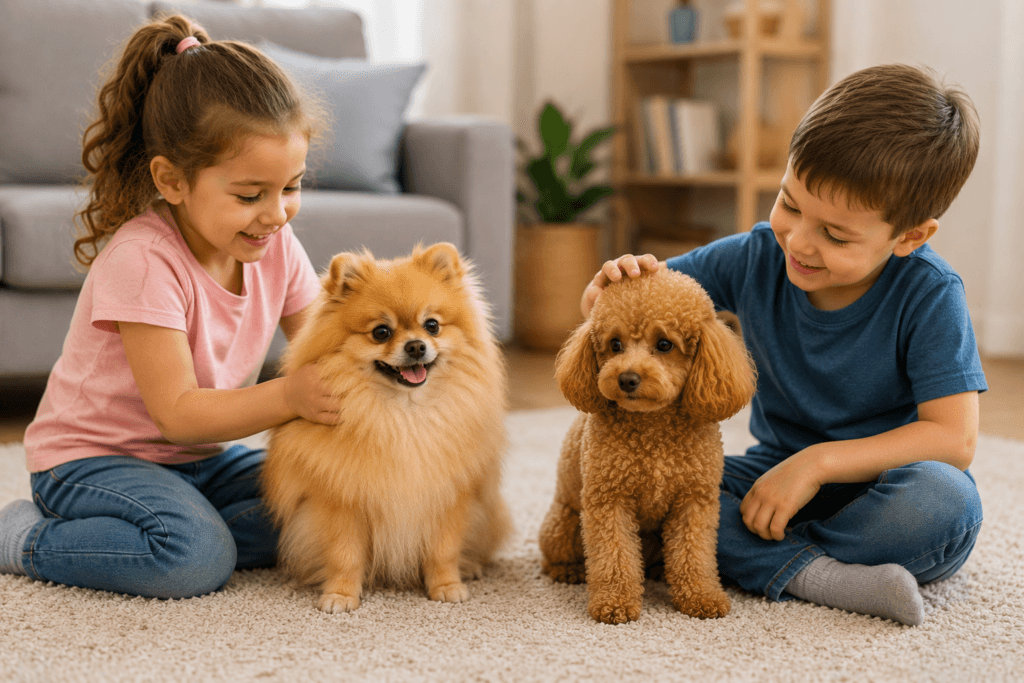
Which Breed Is Better With Children?
Both breeds can make excellent family companions when properly socialized.
However, supervision is important whenever young children interact with small dogs.
Pomeranian
Often suitable for:
- Families with older children
- Active households
- Owners who teach respectful handling
Because of their tiny size, rough play can increase the risk of injury.
Toy Poodle
Toy Poodles often adapt well to:
- Families
- Seniors
- Couples
- First-time owners
Their gentle temperament and eagerness to learn often make them easier to integrate into structured family routines.
Regardless of breed, children should always learn how to approach, hold, and play with dogs safely.
Living in an Apartment
For many Ontario residents, apartment suitability is an important consideration.
Fortunately, both breeds adapt well to condominium and urban living.
Pomeranian
Advantages:
- Small size
- Minimal space requirements
- Indoor play satisfies much of their exercise
Potential challenge:
Without training, alert barking may become excessive.
Toy Poodle
Advantages:
- Quiet indoors
- Adaptable
- Easy to exercise in smaller spaces
Potential challenge:
Insufficient mental stimulation can lead to boredom-related behaviours.
Which Breed Is Better for First-Time Owners?
Many first-time puppy buyers ask whether a Pomeranian vs Toy Poodle is the easier choice.
There is no universal answer.
Consider a Pomeranian if you:
- Enjoy outgoing personalities
- Can maintain regular brushing
- Appreciate an energetic companion
- Want an alert watchdog
Consider a Toy Poodle if you:
- Enjoy training
- Want exceptional intelligence
- Prefer a low-shedding coat
- Can schedule professional grooming
Both breeds benefit from:
- Positive reinforcement
- Early socialization
- Consistent routines
- Veterinary care
- Responsible ownership
Questions to Ask Any Puppy Breeder
Before choosing either breed, ask thoughtful questions that help you understand how the puppies are raised.
Examples include:
- How are the puppies socialized?
- What vaccinations have been completed?
- What veterinary examinations have been performed?
- Can I learn about the puppy’s parents?
- What nutrition has the puppy been receiving?
- What support is available after adoption?
- What recommendations do you have for new owners?
These questions help prospective owners make informed decisions while encouraging transparency throughout the process.
Common Mistakes Buyers Should Avoid
Whether you choose a Pomeranian or a Toy Poodle, avoid these common mistakes:
Choosing based only on appearance
A fluffy coat or adorable face should never be the only deciding factor.
Ignoring grooming needs
Both breeds require lifelong coat maintenance.
Understand the commitment before bringing a puppy home.
Skipping socialization
Early positive experiences help puppies grow into confident adult dogs.
Buying without asking questions
Take time to understand the breeder’s practices, veterinary care, and puppy-raising environment.
Underestimating training
Small breeds still benefit from obedience training and consistent household rules.
Pomeranian vs Toy Poodle: Which One Should You Choose?
There is no single winner.
Choose the Pomeranian if you want:
- A lively personality
- A confident companion
- A playful family dog
- A classic fluffy appearance
Choose the Toy Poodle if you want:
- Outstanding intelligence
- Easy trainability
- Very low shedding
- A highly adaptable companion
Ultimately, the best puppy is the one whose personality, care requirements, and energy level align with your family’s lifestyle.
Frequently Asked Questions About Pomeranians and Toy Poodles
Is a Pomeranian or Toy Poodle better for a first-time owner?
A Toy Poodle may be easier for many first-time owners because it is highly responsive to training and usually enjoys learning new routines. However, Toy Poodles require regular coat clipping and mental stimulation.
A Pomeranian can also suit a first-time owner who is prepared to manage frequent brushing, alert barking, and a confident personality. Consistency, early socialization, and positive reinforcement matter more than previous ownership experience.
Which breed is better for apartment living?
Both breeds can live comfortably in an apartment or condominium when their exercise, training, and enrichment needs are met.
Pomeranians require little physical space, but their alert nature can lead to barking at hallway sounds, neighbours, or visitors. Early training is therefore important.
Toy Poodles are also compact and adaptable. They may be quieter indoors, although boredom can result in unwanted behaviour when they receive too little exercise or interaction.
Which breed is more affectionate?
Both breeds can form strong bonds with their families.
Pomeranians are often outgoing, lively, and eager to remain close to their owners. Toy Poodles may be gentler and more sensitive, frequently becoming deeply attached to one or more household members.
Individual temperament, early experiences, socialization, and treatment within the home can influence affection more than breed alone.
Does a Toy Poodle shed less than a Pomeranian?
Yes. Toy Poodles generally release less hair into the home because loose hairs become trapped in their curly coats. However, their continuously growing coat requires routine brushing, clipping, and professional grooming.
Pomeranians have a thick double coat and shed more noticeably. The Canadian Kennel Club recommends gentle daily brushing to help prevent mats in the Pomeranian’s abundant coat.
No dog is guaranteed to be completely hypoallergenic. Anyone with allergies should spend time around the breed before making a commitment and speak with a healthcare professional about individual concerns.
Is a Pomeranian or Toy Poodle better with children?
Either breed can live successfully with respectful children, but their small size makes careful supervision essential.
Toy Poodles often respond well to calm, structured households. Pomeranians may enjoy active family interaction but can be injured through rough handling, falls, or unsupervised play.
Children should be taught not to pull a dog’s coat, pick up the puppy incorrectly, disturb it while eating, or chase it when it wants space.
Which breed is easier to train?
The Toy Poodle generally has the advantage in trainability. Poodles are known for intelligence, attentiveness, and willingness to participate in structured activities.
Pomeranians are also intelligent, but they may be more independent or easily distracted. Short, reward-based training sessions are usually more effective than punishment or lengthy repetition.
The Canadian Kennel Club notes that toy breeds generally live closely with their owners and commonly respond well to training.
Do Pomeranians or Toy Poodles need more exercise?
Both need daily activity, but Toy Poodles often require more mental engagement.
A Pomeranian may be satisfied with short walks, indoor play, basic training, and regular family interaction. A Toy Poodle often benefits from puzzle toys, scent games, trick training, retrieving, and varied walking routes.
Exercise should be adjusted to the dog’s age, physical condition, and veterinary guidance. Growing puppies should not be pushed into strenuous or repetitive exercise.
What health information should I request before choosing a puppy?
Ask for clear information about:
- Veterinary examinations
- Vaccination and deworming records
- The health history of the puppy’s parents
- Breed-relevant health screening
- Feeding routines
- Any medication or treatment received
- Written purchase terms
- Post-adoption support
- The breeder’s health guarantee, where applicable
Vaccination schedules should be planned with a veterinarian because timing can vary according to the puppy’s age, health, previous vaccines, environment, and local disease risk. The World Small Animal Veterinary Association provides current vaccination guidance for veterinary professionals and encourages owners to consult a local veterinarian.
Final Pomeranian vs Toy Poodle Checklist
Choose a Pomeranian when you are comfortable with:
- A lively, confident personality
- Moderate shedding
- Frequent brushing
- Possible alert barking
- Consistent socialization
- A small dog that enjoys attention
Choose a Toy Poodle when you are comfortable with:
- Regular professional grooming
- Frequent mental stimulation
- Structured training
- A sensitive, people-focused temperament
- A very low-shedding coat
- Maintaining a consistent daily routine
Before deciding, ask yourself:
- How much time can I dedicate to grooming?
- Do I want a bold or more sensitive companion?
- How much training do I enjoy doing?
- Is shedding a major concern?
- Are there young children in the home?
- How long will the dog regularly be left alone?
- Can I afford routine veterinary care and professional grooming?
- Does the puppy’s individual temperament suit my household?
Pomeranian vs Toy Poodle: Final Verdict
The choice between a Pomeranian vs Toy Poodle should be based on lifestyle compatibility rather than appearance alone.
A Pomeranian may be the better match for someone who wants an outgoing, alert, playful companion with a bold personality. Its double coat requires regular brushing, and owners must be prepared to address barking through consistent training.
A Toy Poodle may be better for someone who values exceptional trainability, low shedding, and an adaptable temperament. However, the breed needs frequent grooming, meaningful interaction, and enough mental stimulation to prevent boredom.
Both are small companion breeds capable of forming close relationships with their families. The better dog is the one whose grooming needs, personality, energy level, and care requirements fit realistically into your daily life.
The Canadian Kennel Club describes the Pomeranian as an intelligent, vivacious, alert companion and identifies the Toy Poodle as the smallest Poodle variety, measuring no more than 25 centimetres at the shoulder.
Find the Right Small-Breed Puppy for Your Family
Yavru Patilers features Pomeranian and Toy Poodle puppies for families in Ontario and other parts of Canada. The website also provides information about Maltipoo and Maltese Terrier puppies, breeder information, frequently asked questions, and current availability.
Explore the available Pomeranian puppies and Toy Poodle puppies to compare current options. You can also read more about Yavru Patilers, review the puppy FAQ, or contact the team with questions about temperament, care, availability, pickup, or delivery.
A thoughtful decision now can help you choose a companion whose personality and care requirements remain suitable for your family for years to come.